

You can safely remove a small, exposed wasp nest yourself if nobody in your household is allergic to stings. Treat it in the evening from a distance, wearing full protective clothing. Leave it alone if it is out of the way, because it will die off in the fall anyway. Hire a licensed professional if the nest is underground, inside a wall, hard to reach, or if anyone nearby is allergic. This guide shows you how to tell which situation you are in and what to do in each one.
TL;DR
- A nest that is out of the way can often stay put: social wasp colonies last one season and die off in the fall.
- Remove a nest only when it sits near a door, walkway, play area or other high-traffic spot.
- Treat at dusk or very early morning, from the distance the product label allows, in long sleeves, gloves and a head net.
- Ground nests, wall nests, large nests and any situation involving an allergic person are jobs for a licensed pro.
- Never use gasoline, fire or flooding. They are dangerous and they do not work well.
Table of Contents
- First, Decide Whether the Nest Needs to Go
- Identify What You Are Dealing With
- Wasp Nest Removal You Can Do Yourself
- What Not to Do
- A Wasp Nest in the House, Wall or Roof
- Ground Nests, Yellowjackets and Hornets
- When to Call a Professional
- Perspective: Why We Lean Toward “Leave It or Call Someone”
- Keep Wasps From Coming Back
- More Help From Fix It Daily
- A Quick Plan by Situation
- FAQ
- Sources
First, Decide Whether the Nest Needs to Go
Most people reach for the spray the moment they see a nest. Often that is not the best move. Social wasps prey on caterpillars and flies and help with pollination, and University of Maryland Extension says they should be left alone when they pose no risk to human activity.
Timing matters too. Michigan State University Extension notes that nests that are out of the way and unlikely to be disturbed will die out in the fall, and that after a couple of hard frosts the wasps should no longer be an issue. The colonies are annual: the University of Maryland says they do not reuse old nests, and only fertilized queens survive the winter.
So ask yourself three questions:
- Will anyone walk, mow, play or work within a few feet of it? If yes, it is a hazard. University of Minnesota Extension says nests near a doorway or along a walkway may call for control measures.
- Is anyone in the household allergic to stings? If yes, do not treat it yourself. Hire a professional.
- Is it late in the season? If it is already cold where you live, the colony is winding down, and waiting may be the simplest answer.
If you answered “no” to the first two and the nest is tucked behind a shed or high under a far corner of the roofline, the lowest-risk plan is to watch it from a distance and let the season end it.
Identify What You Are Dealing With
A wasp nest is made of a paper-like material the insects chew from wood fibers and saliva. The University of Maryland notes nests can be found in sheltered hollows, under eaves or branches, and in the ground. A nest starts with a handful of wasps in spring and can hold hundreds by autumn, so a small nest in May can be a big problem by September.
The type of nest changes the plan:
| Nest type | What it looks like | Where you find it | DIY realistic? |
|---|---|---|---|
| Paper wasp | Open, umbrella-shaped comb with visible cells, hanging from a single stalk | Under eaves, porch ceilings, railings, branches | Often yes, if small and reachable |
| Yellowjacket (aerial) | Round or teardrop nest wrapped in a paper envelope | Shrubs, trees, building overhangs | Sometimes, with care and the right spray |
| Yellowjacket (ground) | A hole in the soil with wasps flying in and out | Lawns, banks, gaps under landscaping | Usually no, call a pro |
| Hidden nest | Wasps entering a crack, vent or wall gap | Wall voids, attics, soffits, sheds | No, call a pro |
The University of Maryland says paper wasp combs are exposed, while yellowjacket nests are covered by a paper envelope. Penn State Extension adds that you should work out whether the nest is exposed or hidden, whether it has open combs, and roughly how many wasps it holds, because those factors decide how to manage it.
How to Size It Up Safely
Observe from a distance, at the time of day when wasps are active, and watch the traffic. A few wasps coming and going suggests a young nest. A steady stream suggests a large one. Never get closer to “check” it. If you cannot see the nest but you see wasps repeatedly disappearing into one spot, treat it as hidden.
Wasp Nest Removal You Can Do Yourself
This section applies only to a small, exposed nest you can reach from a safe distance, with nobody allergic in the household. If any of that is untrue, skip to the next section.
Gear to Have on Before You Start
University of Vermont guidance for applying insecticide is to wear a dark-colored, long-sleeved shirt and pants, with socks pulled over the pant legs and gloves over the sleeves, so wasps cannot crawl up inside your clothing. Health Canada also recommends protective clothing including a head net.
Also have:
- A wasp spray labeled for the job, with a reach that suits your nest. Michigan State University Extension says many labels specify a reach of 15 to 20 feet, so you can treat from a distance.
- A flashlight with a red filter or a covered light, so you are not shining a bright beam at the nest.
- A clear escape route, free of toys, hoses and ladders.
- A phone, and someone else at home who knows what you are doing.
If the nest is above ladder height, stop. Spraying from a ladder with a defensive colony overhead is how people get hurt.
Choose the Right Product
For aerosol wasp sprays, the University of Vermont recommends picking a product that lists a pyrethroid such as tetramethrin or sumithrin as an active ingredient. It also notes that aerosol or foaming products are both options. Read the label and follow it exactly. The label is the law for how that product may be used.
Step by Step
- Wait for the right time. Apply insecticide in the late evening or very early morning, according to the University of Vermont. Wasps are least active then and most of the colony is home. Health Canada also says active nest removal is best done in the evening.
- Dress fully before you go out. Tuck, cover and zip. Remove perfume, cologne and scented lotions, which can attract wasps.
- Approach calmly from the direction you plan to retreat. Stay at the distance the label states.
- Spray the nest entrance and surface in one sustained application. Follow the label for how long to spray.
- Walk away. Do not wait to see what happens. Do not swat at wasps. The University of Maryland notes that threatened wasps may release a scent marker that draws reinforcements, so walk away calmly and do not handle individual wasps outside the nest.
- Go inside and stay away for the rest of the night. Check from a distance the next day.
- Repeat if needed. The University of Vermont notes multiple treatments over several days may be needed, especially when entrances are hidden. If wasps are still active after a second treatment, call a professional.
- Remove the nest once it is quiet. Knock it down with a long pole or bag it, wearing gloves, then discard it in a sealed bag.
The Bag Method for Small Paper Wasp Nests
Health Canada describes another option for small, exposed paper wasp nests: enclosing the nest in a plastic bag and detaching the single supporting stalk. It stresses this takes extreme caution and protective gear, and it only works when the nest is small, reachable and attached by one stalk. It is done in the evening, and it is not a job for a nest the size of a softball or larger.
What Not to Do
Some popular tricks make a bad situation worse.
- Do not use gasoline or any petroleum product. The University of Vermont says it must never be sprayed on a nest because it is toxic to you and the environment, and doing so is against the law.
- Do not flood a ground burrow or set a nest on fire. The University of Maryland warns these home remedies may be ineffective and increase the risk of stings.
- Do not spray in the middle of the day. The whole colony is out foraging or defending, and you are the target.
- Do not block a nest entrance in a wall. Trapped wasps can chew or find another way out, sometimes into your living space.
- Do not knock a nest down before it is treated. An intact, active nest on the ground is a disaster in the making.
That covers some of the common searches, like using household sprays or oils. If a product is not labeled for wasps, we would not use it on a nest. A label tells you how far to stand, what protective gear to wear and how the product is meant to be applied.
A Wasp Nest in the House, Wall or Roof
Wasps inside a structure are a different problem. You cannot see the nest, you cannot judge its size, and you cannot safely treat it from a distance. Spraying into a wall void can also push angry wasps toward gaps that open into the room.
The University of Maryland advises hiring a pest control professional when a nest is hard to reach. Wall nests deserve one more step once they are dead: it recommends having the inactive remnants removed so that dead larvae do not attract flesh flies and rodents. The University of Vermont also notes that old wasp nests can attract mice and dermestid beetles, which are small beetles that feed on dead insects and animal matter.
In practice, if you see wasps coming indoors, or hear scratching and buzzing inside a wall or attic, do this:
- Keep the room closed and keep children and pets out of it.
- Note where the wasps enter outside, and the time of day they are most active.
- Do not seal the opening.
- Call a licensed pest control company and tell them what you observed.
If only a few wasps appear indoors in late autumn, they may be drowsy stragglers or queens looking for a place to overwinter. A single wasp in the window is not the same as a nest in the wall.
Ground Nests, Yellowjackets and Hornets
Yellowjackets that nest in the ground are among the hardest to handle at home. The entrance may be a small hole in the lawn. The nest is below, the colony can be large, and wasps will defend it aggressively if a mower or footstep vibrates the soil.
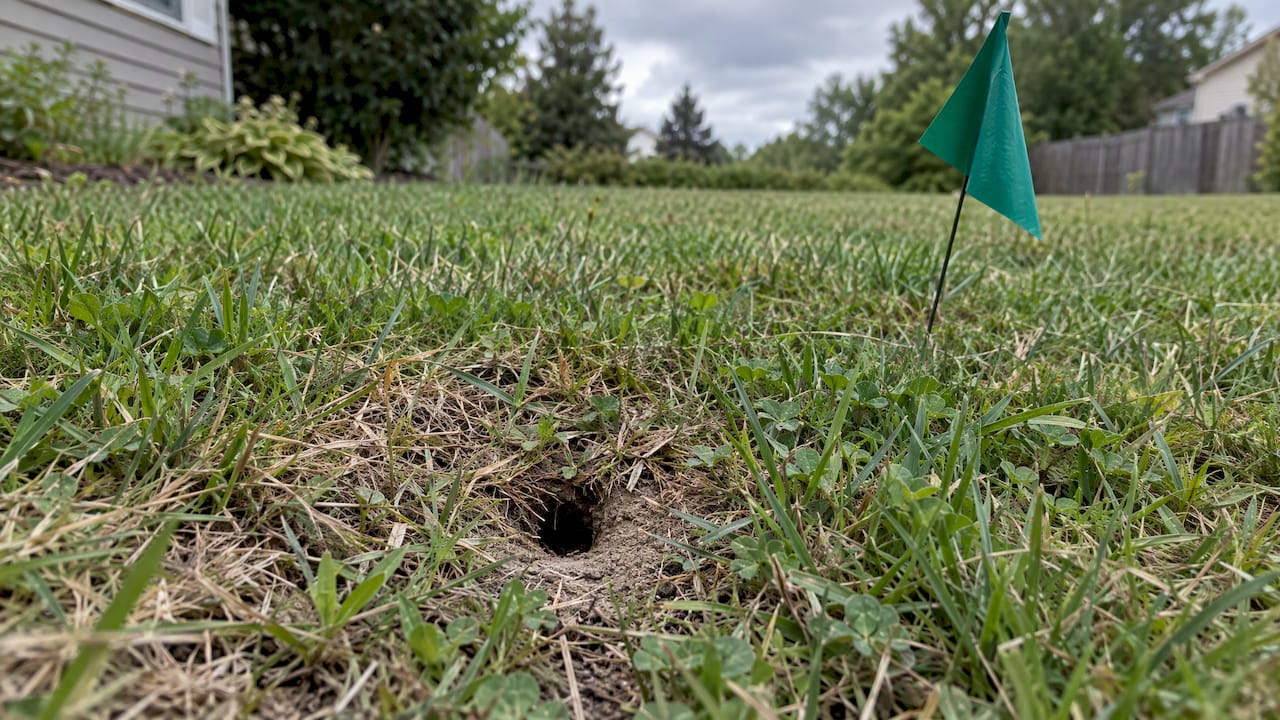
The University of Maryland says that when a nest cannot be avoided until its natural end, a dust or aerosol wasp spray may be needed, and that you should hire a professional if it is hard to reach. For a ground nest, that is our rule of thumb as well. Mark the area from a distance with a cone or flag, keep kids and pets away, and call someone with the right equipment.
If you do decide to treat an aerial yellowjacket or hornet nest yourself, it must be a small one within a safe spray distance, and you must follow the same dusk routine as above.
When to Call a Professional
Call a licensed pest control company if any of these apply:
- Someone in your household, or a neighbor who uses your yard, is allergic to stings. The University of Minnesota says people who are allergic should not attempt to manage a nest themselves and should hire a professional.
- The nest is in the ground, inside a wall, in an attic, or behind siding.
- The nest is above a safe reach from the ground, or you would need a ladder.
- The nest is large, or traffic in and out is heavy.
- You have already treated it twice and wasps are still active.
- You are renting and the nest is on shared property. In that case tell your landlord first, since in many places the property owner is responsible.
Ownership matters in some cities. The NYC Health Department says property owners in New York City are responsible for removing pest bees or wasps on their property and advises contacting a licensed pest control operator. Rules differ elsewhere, so check with your city or county health office or your lease.
Costs and Getting Quotes
We do not quote a single price here, because what you pay depends on your region, the nest type, how high it is and whether the company needs a second visit. What is worth doing is following the University of Vermont’s advice to get several estimates from exterminators before choosing one. Ask each company:
- Is the price for one visit, or does it include a follow-up?
- Do you remove the nest after treating it, or only kill the wasps?
- Are you licensed in this state, and can I see proof?
- What product do you use, and are there re-entry rules for kids and pets?
- Do you offer a guarantee if wasps return?
Perspective: Why We Lean Toward “Leave It or Call Someone”
We write practical repair guides, and most of what we publish encourages you to find the root cause and try a safe first fix before paying for help. Wasps are the exception that proves the rule. The first step is not always a fix. Often the first step is to look, keep your distance and decide whether the nest is actually a problem.
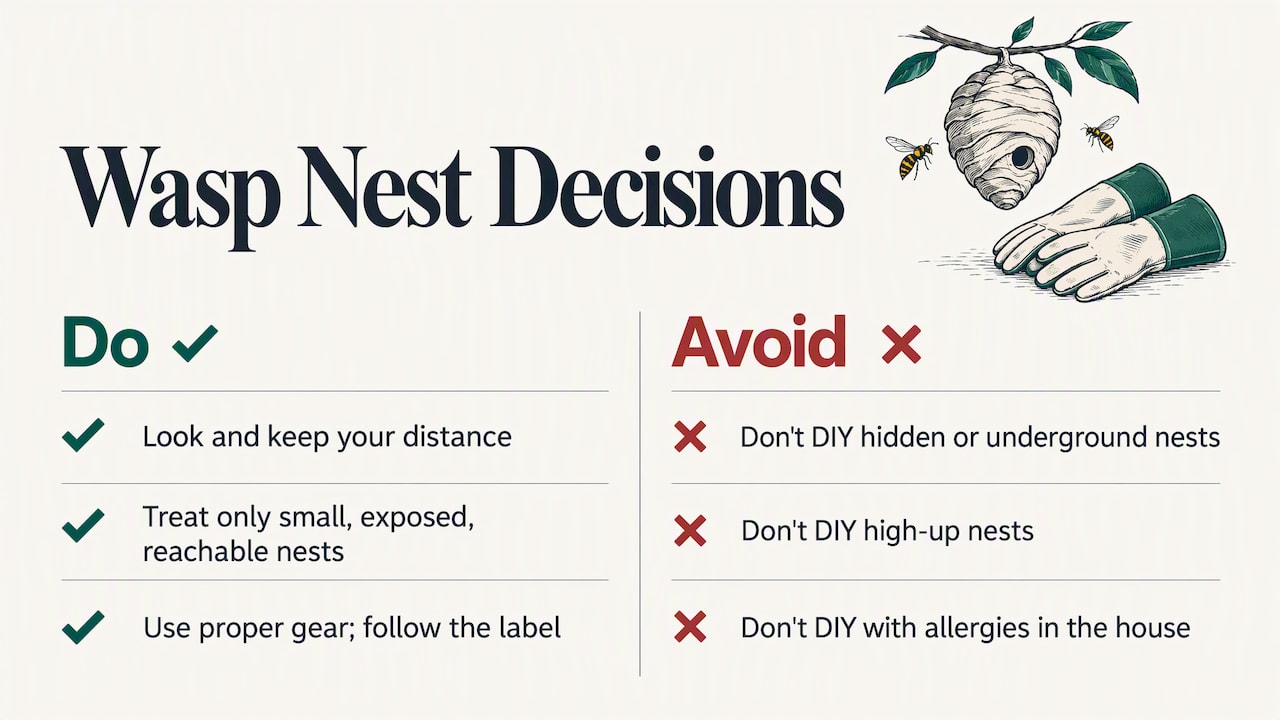
Here is how we think about it. A leaky toilet flapper gives you a second chance if you get it wrong. A defensive colony does not. So the line we draw is clear: small, exposed, reachable and no allergies in the house means you can treat it yourself with the right gear and the label in hand. Anything hidden, underground, high up or involving an allergic person means you stop and call a qualified professional. Stopping is a good decision, not a failure.
We also think the best removal is often prevention. Wasps are drawn to food and trash, and the nest you never get is the one you never have to remove.
Keep Wasps From Coming Back
Old nests are not reused, but new queens look for sheltered sites each spring, and the same sunny eave or shed corner tends to attract them again. Here is what helps.
- Check early. In spring, a new nest is the size of a walnut. Walk the property once a week from April on, looking under eaves, porch ceilings, railings, grills, playsets and sheds.
- Remove old nests. Once the colony has died back after hard frosts, knock down empty nests so they do not attract mice and beetles.
- Close the gaps. Fill ground holes, trim shrubs and branches against the house, and clear yard debris. Repair damaged screens and seal gaps in siding, soffits and vents once you are sure nothing is alive inside.
- Control food sources. The University of Maryland recommends covering outdoor food, using trash cans with tight-fitting lids and avoiding scented products such as perfume or cologne.
- Use traps with care. Health Canada says baited commercial traps may help reduce wasp presence during outdoor events, but they attract wasps, so place them away from play and seating areas.
Wasps can show up alongside other pests that follow food and moisture. If you are also seeing insects in the kitchen, our guide on getting rid of ants in the kitchen walks through the same “find the cause first” approach.
More Help From Fix It Daily
We built Fix It Daily so you can work out what is wrong, try a safe first fix, and know when to stop and call a pro. Wasps are one of the places where that last part matters most. If you want more plain-English guides for plumbing, tech and everyday household problems, start at the Fix It Daily homepage.
When your next problem is a running toilet, a slow drain or weak Wi-Fi rather than a wasp nest, you will find step-by-step help there, with clear safety warnings and honest notes on when a professional is the better call.
A Quick Plan by Situation
| Your situation | Best move |
|---|---|
| Small nest far from foot traffic, late in the season | Leave it and let frost end the colony |
| Small paper wasp nest over the porch, low and reachable | Treat at dusk with a labeled spray, or use the bag method with full gear |
| Aerial yellowjacket or hornet nest in a shrub | Treat only if small and within label range; otherwise call a pro |
| Wasps entering the ground | Mark the area and call a pro |
| Wasps in a wall, attic or soffit | Do not seal or spray blindly; call a pro |
| Anyone allergic to stings | Do not treat; call a pro |
FAQ
How Do I Get Rid of a Wasp Nest Fast?
For a small, exposed nest, the fastest safe method is a labeled wasp spray applied at dusk or very early morning from the distance the label allows. Most of the colony is home then, and wasps are least active. Some nests need more than one treatment over several days. If wasps are still flying after the second treatment, call a professional.
Is It Better to Leave a Wasp Nest Alone?
Often, yes. A nest in an out-of-the-way spot will die out in the fall, and the wasps eat pests along the way. Remove or treat a nest only if it is near a door, walkway or play area, or if someone in your home is allergic to stings. In the allergic case, a professional should do it.
What Should I Do About a Wasp Nest in My House or Wall?
Do not seal the entrance or spray blindly into the wall. Note where the wasps are entering, keep people and pets away from that room, and call a licensed pest control company. Ask them to remove the dead nest material afterward, because leftover larvae can attract flies and rodents.
Should I Use Gasoline, Fire or Water on a Nest?
No. Gasoline and other petroleum products are toxic and illegal to use this way, and fire or flooding can make wasps more defensive without reliably killing the colony. Use a product labeled for wasps, or hire a professional.
How Much Does Professional Wasp Nest Removal Cost?
It varies by region, nest type, height and the number of visits needed. Get several estimates and ask whether the price covers a follow-up visit and nest removal. A company that explains what it will use and what it guarantees is a better sign than the lowest number.
Sources
- Getting rid of wasp nests, Michigan State University Extension
- Social Wasps: Yellowjackets, Hornets, and Paper Wasps, University of Maryland Extension
- Wasps and bees, University of Minnesota Extension
- Getting Rid of Paper Wasps, Yellowjackets, and Other Stinging Insects, Penn State Extension
- Wasps, Health Canada
- Managing Stinging Wasps, University of Vermont
- Wasps, NYC Health
Recommended
More Fixes From Fix It Daily
- How to Stop a Door From Squeaking
- Why Your Laptop Overheats (And What to Do About It)
- How to Remove Grease Stains From Clothes
- Why Your Washing Machine Smells Bad (And How to Fix It)
- Why Your Circuit Breaker Keeps Tripping
- How to Fix Low Water Pressure in a Shower
- Peeling Paint: Why It Happens and How to Fix It for Good
- How to Get Rid of Fruit Flies: Find the Source and Stop Them
- Smoke Detector Chirping? Causes and How to Stop It Safely
- Computer Running Slow? How to Speed Up a Windows PC or Mac